Bone grafting and sinus lift
When the jawbone is too thin or too short to hold an implant, a bone graft builds it up. In the upper back jaw, a sinus lift raises the floor of the sinus to make room for new bone.
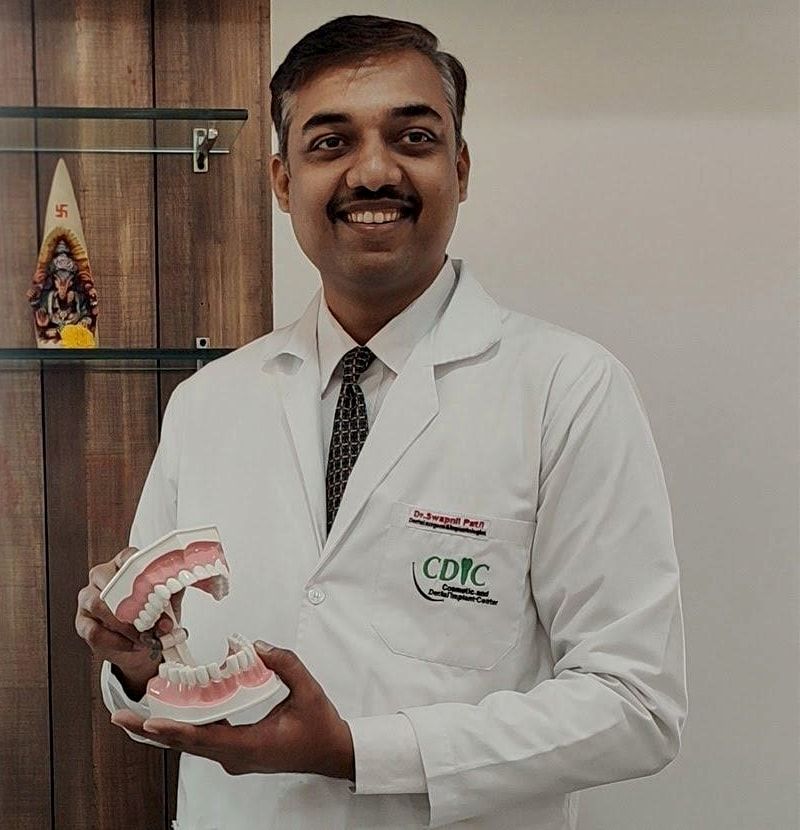
Draft, awaiting review by Dr. Swapnil B. Patil, BDS
Why bone matters for implants
An implant needs bone around it on every side to hold firm. When a tooth is lost, the bone that held its root starts to shrink, quickly in the first months and slowly after that. Years later the ridge may be too narrow or too low for an implant of a sensible size. Gum disease, infection and injury can do the same.
A bone graft rebuilds the ridge. The graft material acts as a scaffold; over the following months your own bone grows into it and replaces it, until there is enough to place the implant.
The sinus lift
Above the upper back teeth sit the maxillary sinuses, air spaces behind the cheeks. When those teeth are lost, the sinus floor often drops and the bone beneath thins, leaving only a few millimetres. A sinus lift raises the thin lining of the sinus floor and places graft beneath it, adding height where an implant needs it.
Sometimes it can be avoided
Not every implant in short bone needs a graft. Angled implants, as used in Smile in a Day, can reach firmer bone further forward. Your 3D scan shows which approach fits your jaw.
It may suit you if
- A tooth has been missing for years and the bone has shrunk
- Upper back teeth are missing and the sinus sits low above the gap
- Gum disease, infection or injury has destroyed bone
- Your 3D scan shows too little width or height of bone for an implant
Suitability is confirmed at your examination, never from a web page.
If you would rather wait
Bone keeps thinning where a tooth is missing, fastest in the first months after an extraction. You can wait, but the graft may need to be larger later. When a tooth is removed, placing an implant or a graft in the socket early can limit the loss.
Step by step
What happens at each stage, and roughly how long it takes. Your own timings are set out in your written plan.
Step 1: Measuring the bone
A 3D CBCT scan, taken in-house, shows the exact width and height of bone at each implant site, and how far the sinus floor lies above it.
Step 2: Choosing the graft
The graft can be your own bone, taken from nearby in the jaw, or prepared bone from a bone bank, or a synthetic material. Each acts as a scaffold your own bone grows into.
The choice depends on how much bone is needed and where. We explain the options for your case.
Step 3: The graft procedure
Under local anaesthesia, the graft is placed where bone is missing and covered with a membrane. For a sinus lift, the lining of the sinus is gently raised and the space beneath it filled with graft.
Step 4: Healing
The graft is replaced by your own bone over the following months.
When there is enough bone to hold an implant firmly, it can sometimes be placed at the same visit as the graft.
Step 5: Placing the implant
Once the new bone has formed, the implant is placed, then the tooth after the implant has healed.
What the cost covers
Cost rangeOn request. Ask on WhatsApp for the Bone grafting and sinus lift price range
Included
- The 3D scan review and planning
- The graft material and membrane
- The graft or sinus lift procedure
Sometimes needed, at extra cost
- The implant and the tooth on it
- A further graft, if the first does not fill the space fully
Anything extra is explained, with its cost, before it is done.
Risks and recovery
Every treatment carries some risk. These are the ones to know about, and what is normal while you heal.
- Swelling and bruising for several days are common, and can reach the cheek after an upper graft.
- A graft does not always take fully, and sometimes needs adding to before an implant can go in.
- After a sinus lift, a mild nosebleed or congestion is normal for a few days. Avoid blowing your nose hard and sneeze with your mouth open while it heals.
- The sinus lining can tear during the procedure. Small tears are repaired at the time.
- Call us if swelling is increasing after three days, if you have a fever, or if you notice a discharge or a bad taste.
Have it at our Wakad clinic
Wakad
Prime City Center, A-6 & B-3, Datta Mandir Road, Shankar Kalat Nagar, Wakad, Pune 411057
Hinjewadi
Our second clinic
Office 102, Adora Commercial Wing, Bhumkar Chowk to Laxmi Chowk Road, Hinjawadi, Pune 411057
What patients say
Read all reviews4.9out of 5
From 578 Google reviews across both clinics, counted in October 2026.
Questions people ask
Not here? Ask us directly. We reply during clinic hours, till 9 pm.
Ask on WhatsAppWhere does the graft bone come from?
From your own jaw, from a bone bank, or a synthetic material. All act as a framework that your own bone gradually replaces.
Does a graft hurt?
It is done under local anaesthesia. Afterwards there is soreness and swelling for some days, managed with the medicines prescribed.
How long before the implant?
Usually four to six months. When enough bone is present to hold the implant firmly, it can go in at the same visit as the graft.
Can I fly after a sinus lift?
Pressure changes can strain a healing sinus, so we usually advise avoiding flying for a period afterwards. If you are travelling, tell us your dates before booking so the timing can be planned.
Related treatments
Smile in a Day
Smile in a Day replaces a whole arch of failing or missing teeth with fixed teeth on four to six implants. The implants and a fixed temporary set go in on the same day; the final teeth follow once the gums have settled.
Full-arch implants
Full-arch implants replace every tooth in a jaw with a bridge held by four to six implants. This page sets out the choices, how many implants, which materials, fixed or removable, and when the teeth go in.
Teeth in an hour
Teeth in an hour refers to the surgical visit, not the whole treatment. The implants are planned on your 3D scan beforehand and placed through a custom guide, so the visit itself is short. Planning comes first; final teeth come later.
Questions before you decide?
Call or message us, or ask for a time. We reply during clinic hours, till 9 pm.