
Teeth whitening
Whitening lightens the natural colour of your teeth with a peroxide gel, either in the chair at the clinic or at home with trays made for your mouth. It does not change the colour of crowns, veneers or fillings.
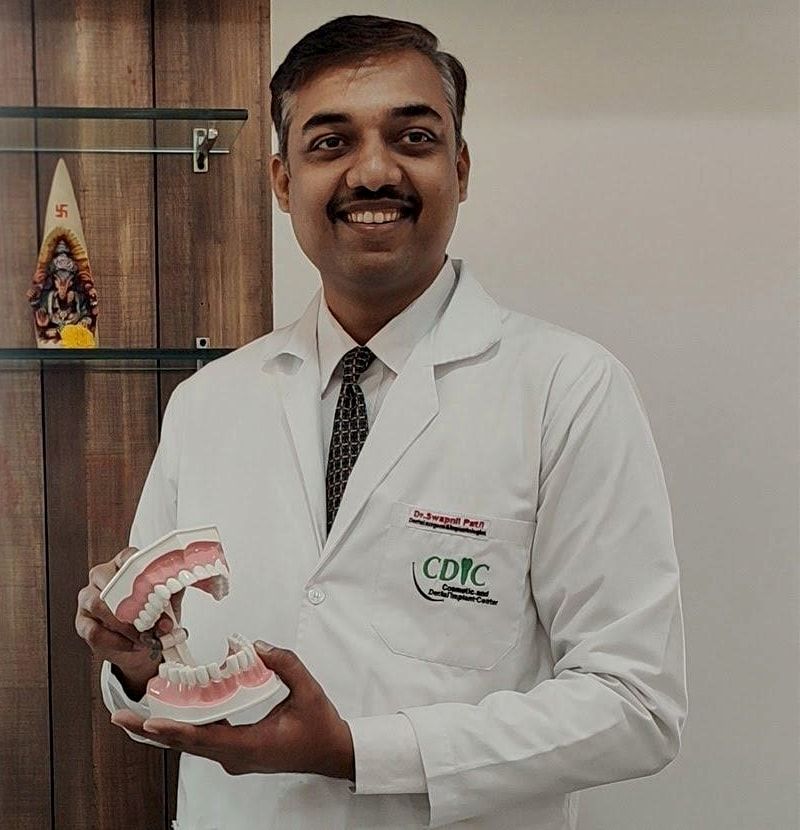
Draft, awaiting review by Dr. Swapnil B. Patil, BDS
How whitening works
The colour of a tooth comes mostly from the layer under the enamel. Over years, tea, coffee, smoking and age stain it from within. Whitening gels contain a peroxide that releases oxygen into the tooth, breaking down those stains and lightening the shade, while leaving the tooth’s structure as it was.
That is also why whitening has limits. It works most reliably on yellowish teeth; grey or banded staining, from certain medicines or a tooth that has died, responds less. For those, veneers or crowns are sometimes the better way to change the colour.
In the clinic, or at home
Clinic whitening uses a stronger gel, applied by us with the gums protected, so you see a change in one visit. Home whitening uses a milder gel in trays made for your teeth, worn daily for a few weeks. It is gentler on sensitive teeth, and the trays can be kept for top-ups.
Keeping the result
The shade drifts back slowly with everyday staining. Rinsing after tea or coffee, not smoking, and regular cleaning keep it longer. A short top-up with home trays every so often is usually all that is needed.
It may suit you if
- Teeth have yellowed with age, tea, coffee or smoking
- Teeth and gums are healthy, with no untreated decay
- You want a brighter smile before an occasion
- You plan crowns or veneers on front teeth and want them matched to a lighter shade
Suitability is confirmed at your examination, never from a web page.
If you would rather wait
Whitening is never needed for your health, so waiting costs you nothing. One timing point matters. If crowns or veneers are planned for your front teeth, whiten first, because they are made to match the shade your teeth are at that moment.
Step by step
What happens at each stage, and roughly how long it takes. Your own timings are set out in your written plan.
Step 1: Shade check and examination
We record the current shade and check for decay, worn enamel, exposed roots and gum problems, which are treated before whitening.
Tell us if your teeth are already sensitive. It changes which method we suggest.
Step 2: Cleaning
A scale and polish removes tartar and surface stain, so the gel reaches the enamel evenly.
Step 3: Whitening in the clinic
The gums are covered with a protective layer, and the whitening gel is applied to the teeth in timed rounds, then rinsed off.
Step 4: Or whitening at home
Thin trays are made to fit your teeth. You wear them with a small amount of gel for the time advised, each day, over a few weeks.
Home whitening is slower but gentler, and the trays can be reused for top-ups later.
Step 5: Comparing the shade
We compare the new shade with the one recorded at the start, and explain how to keep it.
What the cost covers
Cost rangeOn request. Ask on WhatsApp for the Teeth whitening price range
Included
- The shade assessment and examination
- Gum protection and the whitening gel, for clinic whitening
- Custom trays and gel, for home whitening
- A shade check afterwards
Sometimes needed, at extra cost
- A scale and polish beforehand
- Treating decay or sensitivity first
- Replacing visible fillings or crowns to match the new shade
- Top-up gel later
Anything extra is explained, with its cost, before it is done.
Risks and recovery
Every treatment carries some risk. These are the ones to know about, and what is normal while you heal.
- Teeth often feel sensitive for the first day or two, especially to cold. It fades; a sensitivity toothpaste helps.
- The gums can be irritated where gel touches them, sometimes with small white patches that fade within a day or two.
- Crowns, veneers and fillings stay the colour they are, so they can look darker next to whitened teeth.
- Results vary from person to person, and fade gradually with tea, coffee and smoking.
- Whitening is not advised during pregnancy or while breastfeeding.
Have it at our Wakad clinic
Wakad
Prime City Center, A-6 & B-3, Datta Mandir Road, Shankar Kalat Nagar, Wakad, Pune 411057
Hinjewadi
Our second clinic
Office 102, Adora Commercial Wing, Bhumkar Chowk to Laxmi Chowk Road, Hinjawadi, Pune 411057
What patients say
Read all reviews4.9out of 5
From 578 Google reviews across both clinics, counted in October 2026.
Questions people ask
Not here? Ask us directly. We reply during clinic hours, till 9 pm.
Ask on WhatsAppDoes whitening damage the enamel?
Used as directed, peroxide whitening lightens the colour inside the tooth without wearing the enamel away. The sensitivity some people feel is temporary.
How long does whitening last?
Often a year or more, depending on what you eat, drink and smoke. Home trays make occasional top-ups simple.
Will my crowns or fillings whiten too?
No. Only natural tooth changes colour. If a front crown or filling shows after whitening, it can be replaced in the new shade.
Clinic whitening or home whitening?
Clinic whitening gives a visible change in one visit. Home whitening takes a few weeks but is gentler on sensitive teeth. Some people combine the two.
Do whitening toothpastes and strips work?
Whitening toothpastes remove surface stain but do not change the tooth's own colour much. Shop-bought strips contain far less peroxide and work slowly, if at all.
Related treatments
Ceramic veneers
A ceramic veneer is a thin shell of porcelain bonded to the front of a tooth to change its colour, shape or size. It usually needs a small amount of enamel removed, so it is a long-term decision.
Smile makeover
A smile makeover brings several treatments, such as whitening, aligners, veneers, crowns or implants, into one plan, in an order where each step sets up the next.
Clear aligners
Clear aligners are a series of thin, removable plastic trays, each shaped to move your teeth a little further. You change to the next set every week or two until the teeth reach their planned position.
Questions before you decide?
Call or message us, or ask for a time. We reply during clinic hours, till 9 pm.