
Surgical tooth removal
When a tooth cannot simply be lifted out, because it is buried, broken at the gum line or has curved roots, it is removed surgically through a small opening in the gum, under local anaesthesia.
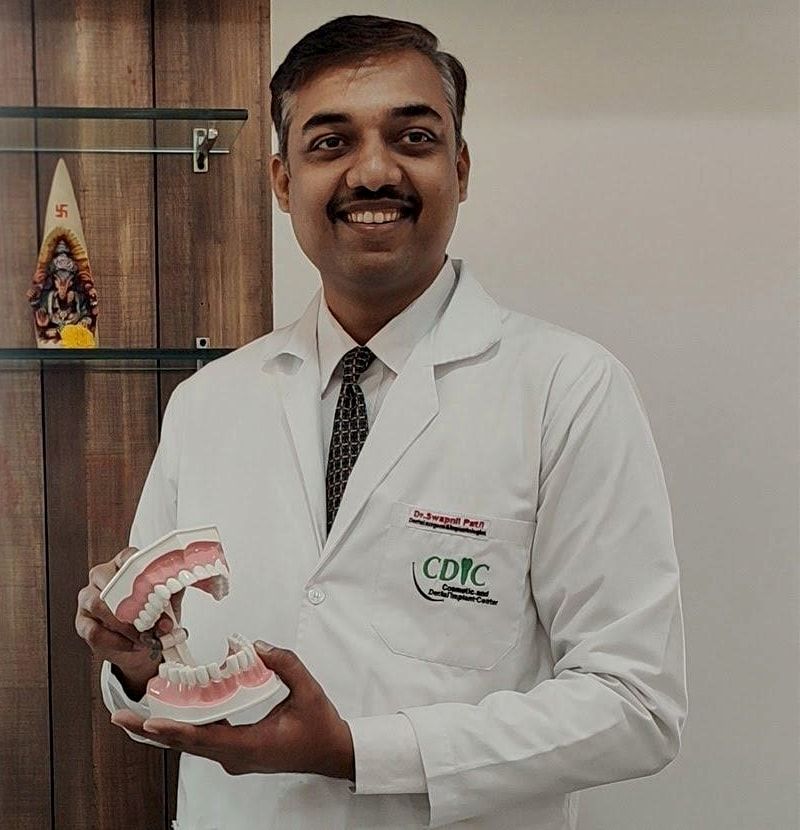
Draft, awaiting review by Dr. Swapnil B. Patil, BDS
When a tooth needs surgery to come out
Most teeth that need removing can be loosened and lifted out in a few minutes. Surgical removal is for the ones that cannot: a wisdom tooth still partly or fully under the gum, a tooth broken off at the gum line, a tooth with long or curved roots, or a root tip left behind from an earlier extraction.
“Surgical” describes the approach, not the scale. A small opening in the gum lets the dentist see and reach the whole tooth, and sometimes the tooth is divided into pieces so that each comes out gently. It is done in the chair, under local anaesthesia.
Wisdom teeth
Wisdom teeth arrive last, usually in the late teens or twenties, and often there is not enough room for them. A tooth that is partly through the gum can trap food and bacteria under the flap of gum over it, which leads to repeated swelling and pain. One that is tilted can push on the tooth in front, or let decay start between the two.
A wisdom tooth that is fully buried, upright and causing no trouble can usually be left alone and checked from time to time. The decision is made on the X-ray and your symptoms, not on age alone.
Planning around the nerve
The nerve that gives feeling to the lower lip and chin runs through the lower jaw, close to the roots of the lower wisdom teeth. When an ordinary X-ray suggests the roots and the nerve are close, a 3D CBCT scan shows the real distance. The scan is taken in-house through Shri CBCT Center, our sister concern, so it does not mean a trip elsewhere.
It may suit you if
- A wisdom tooth is partly through the gum and keeps getting swollen and sore
- A wisdom tooth is pushing on, or decaying, the tooth in front of it
- A tooth has broken off at or below the gum line
- A tooth cannot be saved after decay or a failed root canal
- A piece of root was left behind after an earlier extraction
Suitability is confirmed at your examination, never from a web page.
If you would rather wait
A buried wisdom tooth that causes no trouble can often stay where it is, checked on an X-ray at your routine visits. One that keeps swelling, traps food or is damaging the tooth beside it tends to get worse, and removal is usually simpler in your twenties than later in life.
Step by step
What happens at each stage, and roughly how long it takes. Your own timings are set out in your written plan.
Step 1: Examination and X-ray
An X-ray shows the position of the tooth and its roots. For a lower wisdom tooth whose roots sit near the nerve, a 3D CBCT scan, taken in-house, shows exactly how near.
Knowing where the nerve runs is what keeps this procedure safe and predictable.
Step 2: Numbing the area
Local anaesthesia numbs the tooth, the gum and the bone around it. You feel pressure and movement, not pain.
Step 3: Removing the tooth
A small opening in the gum gives access. Where needed, a little bone around the tooth is eased away, or the tooth is divided into sections so each comes out without force.
Step 4: Closing the socket
The socket is cleaned and closed with a few stitches. You bite on gauze for a while so a clot can form, and go home with written aftercare.
Step 5: Review
We check the healing and remove the stitches if they are not the dissolving kind.
What the cost covers
Cost rangeOn request. Ask on WhatsApp for the Surgical tooth removal price range
Included
- The examination and the X-ray on the day
- Local anaesthesia
- The surgical removal and the stitches
- The review visit afterwards
Sometimes needed, at extra cost
- A 3D CBCT scan, when the roots lie close to the nerve
- Medicines prescribed for after the procedure
- A bone graft in the socket, if an implant is planned there later
Anything extra is explained, with its cost, before it is done.
Risks and recovery
Every treatment carries some risk. These are the ones to know about, and what is normal while you heal.
- Swelling and jaw stiffness are normal and usually peak on the second or third day, then settle.
- Oozing of blood for the first day is normal. Bite firmly on gauze; call us if bleeding is heavy or will not stop.
- A dry socket, where the clot is lost, causes a throbbing ache from about the third day. Smoking makes it far more likely. Call us; it is treatable.
- Rarely, numbness of the lip, chin or tongue follows the removal of a lower wisdom tooth. It is usually temporary. Planning on a 3D scan lowers the risk.
- Call us if swelling is still increasing after the third day, if you have a fever, or if you cannot open your mouth.
Have it at our Wakad clinic
Wakad
Prime City Center, A-6 & B-3, Datta Mandir Road, Shankar Kalat Nagar, Wakad, Pune 411057
Hinjewadi
Our second clinic
Office 102, Adora Commercial Wing, Bhumkar Chowk to Laxmi Chowk Road, Hinjawadi, Pune 411057
What patients say
Read all reviews4.9out of 5
From 578 Google reviews across both clinics, counted in October 2026.
I recently had my wisdom tooth removed by Dr. Swapnil Sir, and the entire treatment was incredibly smooth, easy, and completely fearless.
Questions people ask
Not here? Ask us directly. We reply during clinic hours, till 9 pm.
Ask on WhatsAppWill it hurt?
The area is numbed, so during the procedure you feel pushing and pressure rather than pain. Afterwards it is sore for a few days; ordinary painkillers and the aftercare steps keep most people comfortable.
How much time should I take off?
Plan to rest for the rest of the day. Many people are back at a desk within a day or two after a straightforward removal, though swelling may still be visible. A difficult lower wisdom tooth can take a few days longer.
Should all my wisdom teeth come out?
Not as a rule. Only the ones causing problems, or clearly heading that way, need removing. Healthy, well-placed wisdom teeth can stay.
What is a dry socket?
It happens when the blood clot in the socket is lost early, leaving the bone exposed. It causes a deep, throbbing ache a few days after the removal. Avoiding smoking, straws and vigorous rinsing for the first days lowers the risk. If it happens, we clean and dress the socket.
I take blood thinners. Can I still have a tooth removed?
Usually, yes. Tell us every medicine you take before the appointment. Some need no change; for others we plan with your doctor. Never stop a prescribed medicine on your own.
Related treatments
Single-visit root canal treatment
Root canal treatment removes the infected nerve inside a tooth, cleans and seals its canals, and lets you keep the tooth. When the tooth allows, it is done in one visit.
Crowns and bridges
A crown is a cap that covers and protects a weakened tooth. A bridge replaces one or two missing teeth by fixing a false tooth to the teeth on either side of the gap.
Questions before you decide?
Call or message us, or ask for a time. We reply during clinic hours, till 9 pm.